Whether you’re new to healthy living and want some tips to get started or you’re just looking for quick and healthy recipes, you’ve come to the right place.

Hi, I’m Megan Gilmore. I’m a certified nutritionist consultant (CNC) and busy mom of 2 kids, and I love sharing healthy recipes that are quick & easy to prepare.
What is a Detoxinista?
The body comes equipped with everything it needs to detox, including organs like your liver and kidneys. So, you won’t find any drastic detox fads over here.
Instead, I like to share easy & delicious recipes that are made with whole-food ingredients, to help support your body’s natural detoxification process. By eating more nutrient-rich foods, and less processed ones, you’ll naturally support your body, without doing anything drastic.
My hope is that these recipes will help you squeeze a little more nutrition into your life, without feeling like you’re missing out on any of the flavors you love. The recipes I share here are: gluten-free, made with real ingredients, including short ingredient lists, and super easy to prepare.
My Approach to Detox
I used to struggle with binge eating, so now I don’t adhere to any super-strict rules or guidelines when it comes to eating. Our bodies come equipped with everything we need to detox on a daily basis, but we can help support it by:
- eating more real, unprocessed foods
- eating less processed and packaged items
- practicing food combining, to optimize digestion (no cutting out food groups!)
- moving your body every day
Making consistent changes that you can stick to is the way you create lasting results, so I hope you’ll find some healthy recipes here that will make you look forward to eating well every day!
Education & Certifications
I have a bachelor’s degree in Visual Communications, and later trained at the Institute for Integrative Nutrition. I also studied clinical nutrition at the Natural Healing Institute, becoming a Certified Nutritionist Consultant (CNC), and trained with Clinical Nutritionist and Detox Expert, Natalia Rose in Intelligent Detox Counseling.
Featured Interviews
You can watch me on: Pickler & Ben, Hallmark’s Home & Family (here’s another one), The 700 Club, KTLA, and Kansas City Live. You can listen to me on the following: Wellness Mama, Food Blogger Pro, Chopped, and Free Spirit Academy. I’ve also been featured on Forbes, BuzzFeed, Oprah.com, Greatist, The Guardian, Huff Post, Clean Eating Magazine, and more.
Frequently Asked Questions
My recipes are copyrighted, but you are welcome to share one of my photos with credit and a link back to the full recipe on my website.
I believe it’s more important to focus on the quality of the food you eat, rather than a self-imposed calorie or macronutrient limit. However, if using nutrition information is imperative for your own lifestyle, you can calculate the nutrition information for any of my recipes using a free website like MyFitnessPal. (They have a really easy tool where you can just copy the URL of the recipe you want to calculate!)
I received my nutrition training from the Institute of Integrative Nutrition and NHI College. If you have any questions about IIN, please read through my IIN FAQ.
In addition, I’ve also trained in Intelligent Detox Counseling with clinical nutritionist Natalia Rose, and attended the Detox Culinary Institute with chef Doris Choi.
Goat’s milk has a smaller protein molecule, making it significantly easier to digest than cow’s dairy. People who are mildly lactose-intolerant can often tolerate goat’s milk just fine. You can read my full post about why goat’s milk is better than cow’s milk here.
Juicing removes the fiber of the vegetables, quickly flooding your body with nutrients, without needing to go through the digestive process. This is thought to give your body a rest, saving your energy to work on other areas of the body. Blending veggies does not remove the fiber, it simply makes it easier to digest by breaking down the veggies before consumption (like “chewing” them for you!).
One option isn’t necessarily “better” than the other; it completely depends on the person and each individual situation. Personally, I like to drink both.
Many suffer from Candida overgrowth, and there is much debate on the best approach to battle it. In my own experience, I’ve used Natalia Rose’s Detox 4 Women plan. I also recommend reading Breaking the Vicious Cycle, for a different approach to healing digestion, and therefore, also starving yeast. You can also see the candida tools I’ve personally tried on my Resources page.
You can find all of my favorite health and nutrition books on my shop page.
My favorite kitchen tools are also listed on my shop page.
I receive a LOT of substitution questions, and I don’t always know the answer to them. Grain-free baking is especially tricky, so a “trial and error” approach is usually what works best. As a general overview, here are a few substitution options to replace:
Blanched almond flour: Ground almond meal, or any other ground nut or seed meal should work (i.e. sunflower seeds, walnuts, pecans, etc.), though the flavor may be affected with any substitution. Coconut flour will NOT replace any other flour– it’s tricky! Grain-based flours and other gluten-free flours will also NOT work as a substitute for a nut-based flour.
Almond butter or peanut butter: Any other nut butter can be substituted, but since some are oilier than others, results may vary. For those allergic to nuts, sunflower seed butter may be used as a substitute. A word of warning about baking with sunflower seed butter–> when mixed with baking soda, it can turn baked goods GREEN! The results are totally safe to eat, but it can be a shock if you’re not prepared for it.
Sunflower Seed Butter: Any nut butter, such as almond, cashew, or peanut butter, will work as a substitute. Keep in mind that nut you choose may affect the flavor, and oily nuts such as pecans or macadamias may affect the texture.
Butter: Coconut oil or palm shortening can be used interchangeably with butter.
Coconut Oil: Butter or palm shortening can be used interchangeably with coconut oil.
Honey: Pure maple syrup, brown rice syrup, or coconut nectar may be used instead. I don’t recommend using agave, as it’s highly processed and very high in fructose. If you’re looking to avoid sugar all together, I prefer NuNaturals stevia, as it doesn’t have a bitter aftertaste like other stevia products on the market. When baking with stevia, be sure to add extra to taste, as some of the sweetness is removed with heat.
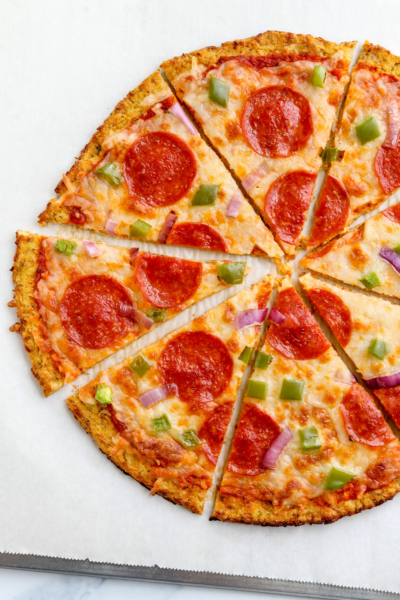
Goat cheese: In most cases, any type of cheese will do. It can also be omitted completely, as in the case of my cauliflower pizza crust, but the results may vary. For a vegan “cheese” flavor, nutritional yeast can be added to many recipes.
Eggs: Flax or chia eggs will work in many cases, especially in cookies. For recipes calling for more than one egg, as in muffins or cakes, the resulting baked goods will NOT rise as well with flax or chia eggs. One mashed banana may also be used in some recipes, and I’ve heard great things about Ener-G egg replacer, but have not tried it myself.
Extensive Meal Plans
View Menu Plans
My Cookbooks
View More Details