
This post may contain affiliate links. Please read my disclosure and privacy policy.
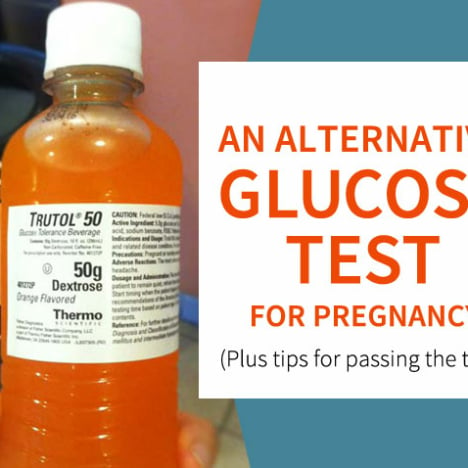
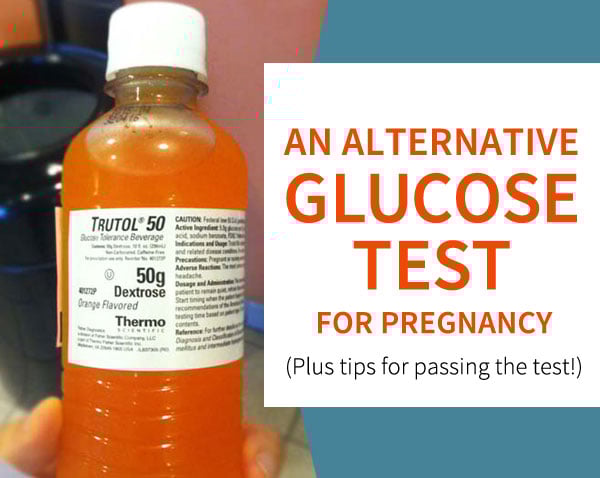
During my first pregnancy, I was required to consume the neon-orange colored glucose drink not once, but twice, to test for gestational diabetes. I failed my first test by a few points, so I had to follow that one up with the 3-hour test, which is even worse!
Luckily, I passed my 3-hour test with flying colors, but I nearly fainted during the process.
During my second pregnancy, I was determined to find a better way. Though I worked with a very traditional doctor for my next pregnancy, she was open-minded to trying an alternative as long as it would be accurate. (See the other alternatives towards the bottom of this post, which my doctor did not consider an accurate measure for gestational diabetes.)
Disclaimer: If you’re seeking an alternative to the traditional Gestational Diabetes Test for pregnancy, I hope that sharing my own experience is helpful, but it’s not intended as medical advice. Please note that I am not a medical professional; therefore, it is essential to consult with your own doctor to develop a personalized plan tailored to your specific needs.
My Alternative Gestational Diabetes Test
Instead of consuming the glucose drink, my doctor recommended that I test my blood sugar four times a day using a glucose monitor.
I did this every day for one week, when I hit the 30-week mark in my pregnancy.
- Pros: What I love about this approach is that I get to see how my body handles the real food I eat on an everyday basis. This seems like it will provide a more accurate result compared to drinking a glucose beverage that I would have never chosen on my own.
- Cons: The only downside is that I hate needles, and poking my finger 4 times a day isn’t fun. But after the first few times, I got the hang of it. This alternative simply involves testing my blood first thing in the morning (to obtain my fasting number) and then testing it again 2 hours after each meal, for a total of four times each day.
What happens if you decline the Gestational Diabetes Test?
After talking to my doctor, testing my blood sugar like this is what I would have to do if I were to skip the test for gestational diabetes altogether. They would treat me as if I had diabetes to be on the safe side, and I’d have to test my blood sugar 4 times a day until I gave birth.
The only issue I’ve had with this method is that during this pregnancy, I tend to graze all day long. So, I have to consciously NOT eat so that I have 2 hours for my body to process the food I’ve consumed and can get an accurate blood sugar reading.
To accommodate the test, I drank my morning smoothie and ate my mid-morning snack at the same time, so that my body wouldn’t get too hungry while I waited the 2 hours before testing.
How Different Foods Affect My Blood Glucose Levels
As it turns out, my glucose numbers were great, so I started having a little bit of “fun” while I was using the glucose monitor. By fun, I mean I tried out different food combinations to see how they affect my glucose levels.
For example, yesterday I had an all-fruit meal for breakfast to see if it would spike my blood sugar the way everyone always assumes it will, and in contrast, I had a low-carb breakfast another morning to see how my blood sugar responded to that. Below are my results!
All-Fruit Breakfast
Most experts agree that in a healthy person without diabetes, your blood sugar will spike (regardless of what you eat) 45 minutes to an hour after a meal. This is why you test 2 hours after a meal, because your blood sugar should return to normal by then. I’ve always been taught that fruit digests faster than any other food, and according to my glucose numbers, that theory is correct.
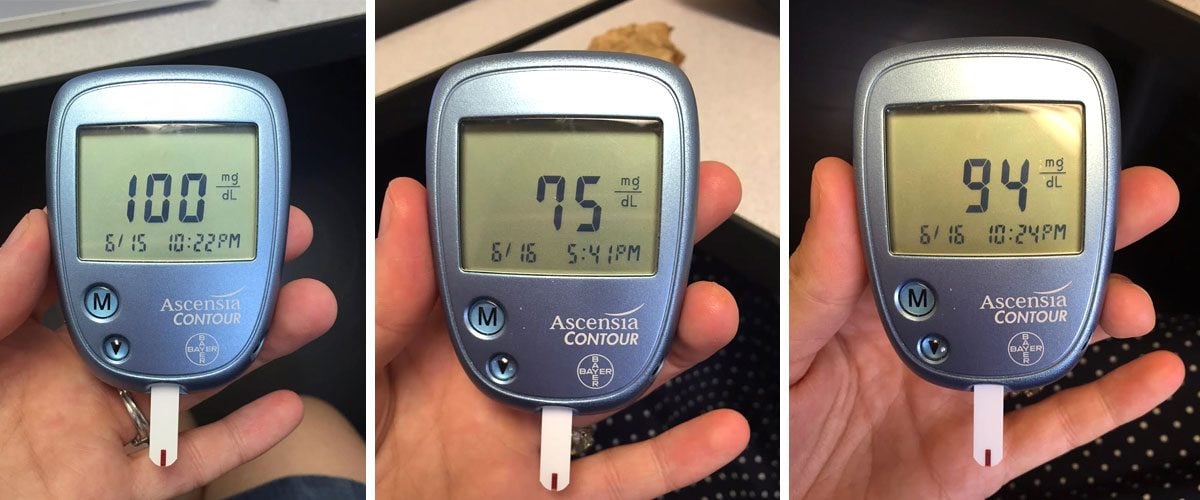
My glucose reading after the all-fruit meal, which contained a whopping 92 grams of natural sugar, was by far the lowest glucose number I’ve had all week! I assume that’s because my body was able to process the natural sugar and get it out of my bloodstream as quickly as it had entered.
This number is actually borderline low, and my body was definitely telling me it wanted more food at this point, but I waited the full 2 hours post-meal because I wanted to be as consistent as possible with these readings.
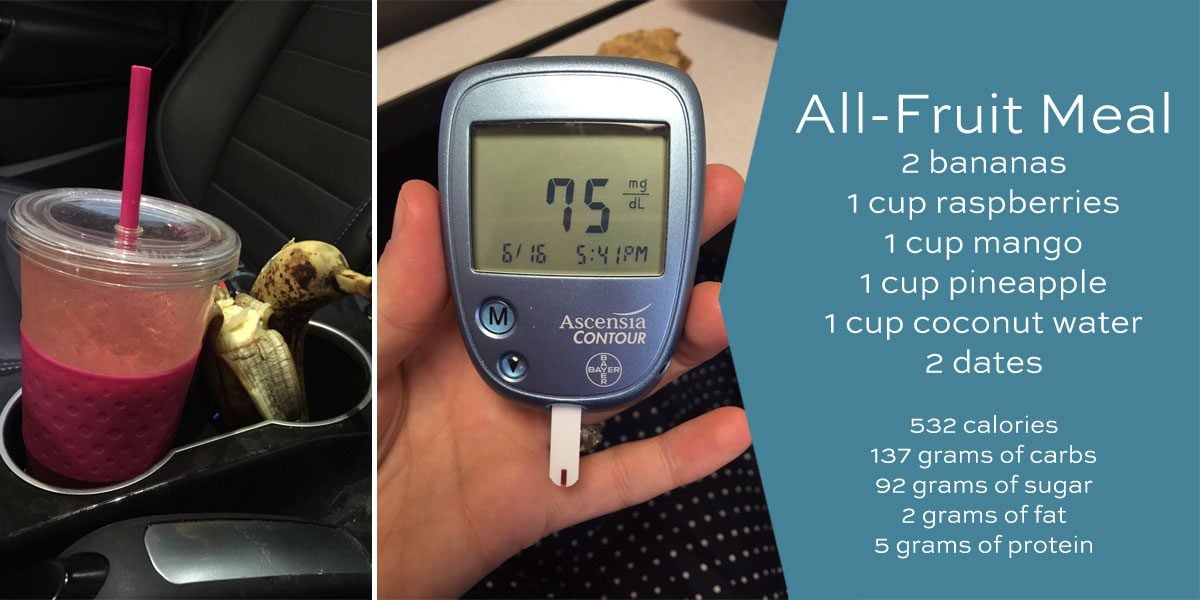
This is why I don’t fear fruit. I am curious to see what would happen to my blood sugar if I ate 92 grams of refined sugar in one sitting, but at the same time, I don’t necessarily want to do that to my body or baby to find out.
Although, on a side note, when I took the 3-hour glucose test during my first pregnancy, my blood sugar wasn’t nearly that low at the 2-hour mark, so my body definitely struggled to get that processed sugar out of my bloodstream when compared to my all-fruit meal above.
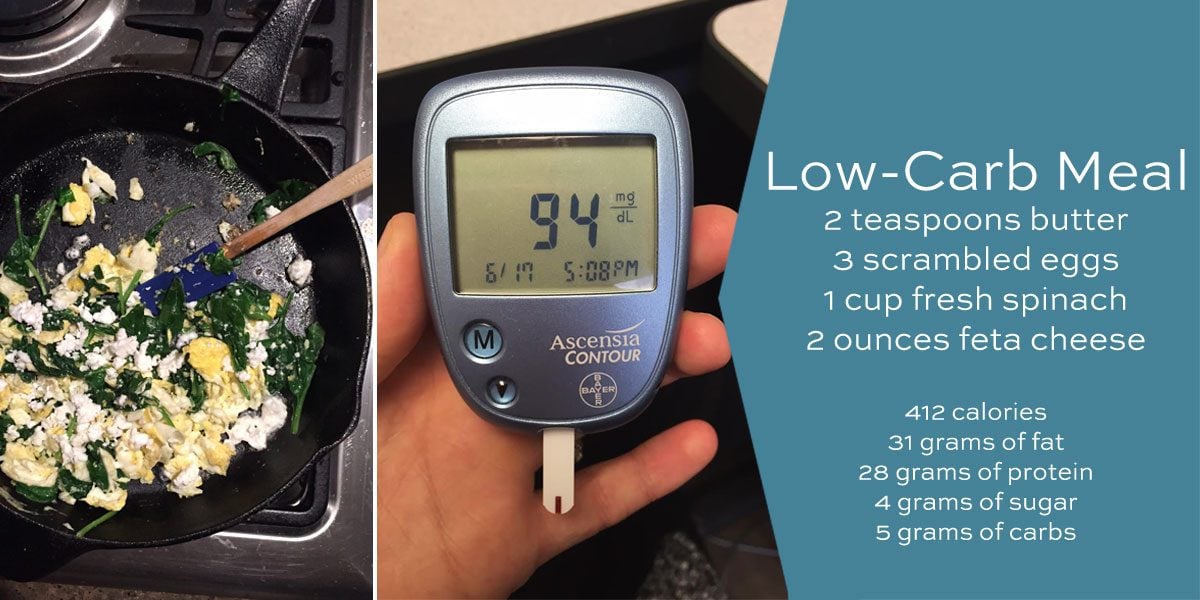
Low-Carb Breakfast
To compare and contrast with the all-fruit meal, I had a low-carb breakfast the following morning, which contained only 4 grams of naturally occurring sugar, found in the eggs and cheese. My glucose reading was about average after this meal, not any lower than other normal meals I had eaten this week (94 has been my average post-meal reading).
I found this interesting since the whole meal consisted of only 5 grams of carbohydrates and my other meals are much higher in carbs. I wonder if the higher fat content kept even that small amount of sugar in my bloodstream longer, as I’ve read that fat could be a culprit behind higher blood sugar readings.
Turkey Wrap Lunch
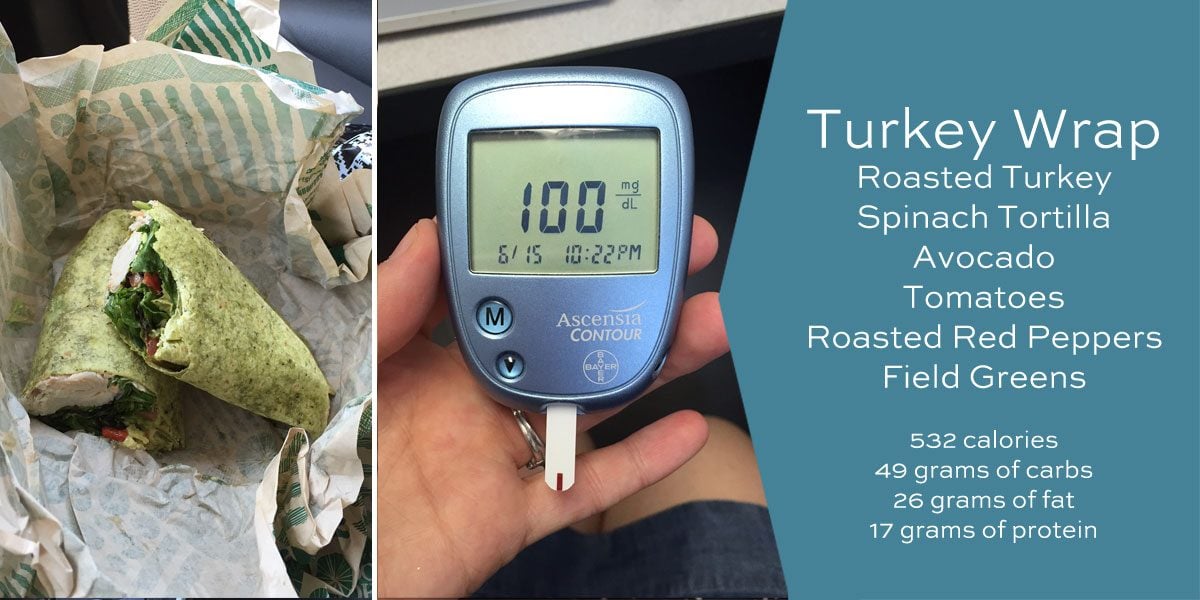
Out of curiosity, I’ve also tried to eat some typical lunches, like a turkey sandwich wrapped up in a tortilla, which contained a decent amount of carbs, protein, and fat. I’ve had a busy week running errands during my lunch break, so I picked up this wrap at Whole Foods —it’s made to order with warm turkey, field greens, tomato, red pepper, and avocado wrapped in a large spinach tortilla.
Out of all my meals, this one left me with the highest glucose reading I’ve had all week. (Though any reading under 120 is considered perfectly fine as a post-meal glucose reading when testing for gestational diabetes.)
Why It’s Important To Keep Monitoring Blood Sugar
To be on the safe side, my doctor asked me to continue testing my blood sugar every few weeks until the baby was born. I love that this alternative test allowed me to continue monitoring my blood sugar levels throughout the rest of my pregnancy, since gestational diabetes can develop late in the game.
Luckily, that wasn’t the case for me, and I went on to have a healthy childbirth.
Other Glucose Test Alternatives
In case you’re curious, here are some other alternatives to the glucose test that I discussed with my doctor, along with why she doesn’t recommend them:
- A1c Blood Test. This blood test can provide an average of your blood sugar level over the last 3 months or so, which is ideal for testing for diabetes in non-pregnant individuals. The reason why my doctor doesn’t like this test for determining gestational diabetes is that this condition typically won’t show up until much later in pregnancy. In fact, that’s why she didn’t even want me to test my blood sugar until I was 30 weeks along, because gestational diabetes might not make an appearance until the last 8 to 10 weeks of pregnancy. So, it doesn’t really matter what my blood sugar average has been over the last 3 months– I could still develop diabetes, and it could go undiagnosed if we relied on the A1c test.
- Eating an equivalent amount of glucose in food or fresh juice. I’ve heard that some midwives will allow their clients to consume a certain amount of grapes, orange juice, or jelly beans to reach the 50g of glucose found in the standard orange drink. My doctor wasn’t comfortable with that idea because she felt there were too many variables involved. Since food can vary, she was afraid I’d be eating too much or too little sugar and wind up with an inaccurate result– which could potentially lead to undiagnosed diabetes, or falsely diagnosed diabetes, neither of which is ideal. Here’s a research study on jelly beans as an alternative.
Dye-Free Glucose Tolerance Drink
I hope you all find this post useful and that it may help any pregnant women in the future know that there are alternatives to the neon-orange glucose drink, even if you have a very traditional, mainstream doctor.
If nothing else, I learned this time around that they do make a dye-free drink, which would make me feel a little better about drinking it three years ago. Why don’t they make that the standard?
How to Pass the Glucose Tolerance Test for Pregnancy
If you have no choice but to take the glucose test, I’ll pass on this tip that my doctor shared with me: Rather than eating a low-carb meal before you take the test, as so many doctors recommend, she actually recommends eating a low-fat, higher-carb meal because the body seems to respond to the test better that way. (Possibly because the blood clears out simple sugars faster than it does fat, as shown by my numbers above?)
Since false positives are fairly common with the one-hour glucose test, I wonder if this tip might help prevent them. Also, it’s not uncommon for fasting numbers to be higher than post-meal numbers, so if I had to do it again, I would definitely eat something 2 hours before taking the one-hour test. (You must fast for the 3-hour one, so it’s not an option there.) I fasted for my one-hour test the last time, and failed it by one or two measly points, but went on to pass my 3-hour test with flying colors.
Reader Feedback: If you’ve ever been pregnant, did your doctor offer you an alternative to the glucose test? I’d love to hear if there are any other options available!











Hello all!! I am due for the glucose test but my dr agreed to let me have it done at home(poking my finger 4 times a day for 4 weeks)and I could not be happier this way. I have been analyzing my levels one hour after each meal, and the average is 110-120. I should try some days two hours after meals. One night it was high, I ate icecream, and it completely spiked the level. I should have had less than 140 but mine was 156. My question is, the average number during these 4 weeks counts or the fact that I spiked one night/reading then I have GD? Please, I would appreciate an advice/opinion/suggestion. I am a super healthy eater, I even made cookies at home just with banana, apples and almond flour and the number was lower than ever. I am also afraid to tell the dr because it is a liability for them and I do not want to have me done the glucose test and crazy medication afterwards, but ai can definitely diet on my own. Thank you so much.
My OB ordered an early glucose test at my 12-week appointment. Annoyingly, he added that test to my checkout sheet and then handed it back to me without discussing. I have about a week and a half before I go in and I’m so upset that he didn’t even discuss it with me. My risk factors are obesity and being 35 years old. My previous pregnancy, I had a large babe but passed two glucose tests in later pregnancy with flying colors. I’m strongly considering declining such an early test as I feel like it is so premature! Thoughts?
Hey Megan!!
I love your blog and have used so many of your recipes over the years!!
My name is Katelyn and I am the founder of a company called Glucoganics. We are the only certified organic alternative beverage for the glucose tolerance test. We only use 3 ingredients (organic sugar, organic lemon juice, and water) and are packaged in glass!
I would love for your readers to know about this option to empower them to have the pregnancy they deserve! Please let me know if I can offer a discount code 🙂
Best,
Katelyn
I’d love a discount code please!
I fainted after the orange drink with both pregnancies. The Dr. & phlebotomists told me that the drink wasn’t causing this. I’m glad to hear that you had this result also. I feel that I did have gestational diabetes but it went undiagnosed, despite doing that test. I wish I would have been offered the alternative. Thanks for your article.
Hi, thank you so much for sharing but unfortunately my Dr didnt discuss any other alternatives. However I did read from another Mother about the Hemaglobin A1C test which my Dr didnt offer as an alternative. Except that a fasting GL test was the only option as I had tested G.D from my last pregnancy so I think I will be doing a high carb low fat breakfast 2 hrs before my GL test this time round. Thanks for the tip.
I’ve had gestational diabetes and learned a thing or two over the past couple of years as I try to wars off type 2 diabetes. I need to warm you that your blood sugar result after your fruit breakfast being the lowest is actually not a good sign. If you were to test at 30 mins and 60 mins as well as the 2 hour mark, you’ll see what I mean. I bet you find that your spike is higher than optimal. If you go above 140mg ( 7.8mmol ), they say that is where cell damage starts happening, and the lower 2 hour result just means a larger amount of insulin was shot out (and slightly overshot) to deal with all that fructose, which, by the way, is the sugar that gives us fatty liver. If you keep on with the high sugar, you may find that 2 hour result gets lower and puts you into a hypo range, and then over time, as the pancreas burns out and can’t produce the insulin needed for that amount of sugar, all of your blood sugar results will rise and it will be too late to prevent it. You’re better off now researching insulin resistance and stick to low carb if you want a gulit free piece of fruit into your old age. Low carb is also, iny experience, the best way to lose the baby weight. Just don’t go too hard while you’re still breastfeeding if you want a good supply.
That’s definitely one point of view! Another would be to check out Mastering Diabetes, where they use a high-fruit method to reverse Type 2 diabetes, or manage Type 1 diabetes. There’s all sorts of approaches to managing blood sugar, so it’s definitely not one-size-fits-all.
I have actually heard about that Mastering Diabetes method of high carb low fat too. Most of us would be hopeful that we can avoid diabetes without having to give up all the sweet stuff so I was hoping that would work for me too. But I think it might only be appropriate for T1 diabetics for a number of years if the person is not overweight and hasn’t already got insulin resistance.
And then I also think of Professor Tim Noakes? (a South African scientist, and an emeritus professor in the Division of Exercise Science and Sports Medicine) who was eating (and endorsing) a high carb low fat diet while running marathons, and he ended up prediabetic and has now changed completely to support the low carb high fat way of eating.
I also have read that sugars, which means carbs, fructose included, will feed cancers, and didn’t Steve Jobs die of pancreatic cancer while drinking nothing but apple and carrot juice?
Personally, I think not overeating is the first step, and not being too extreme unless you are already extremely ill, is probably sensible. There are people who live to 100yo who still eat a bowl of pasta with cheese on top and whatever fruit they like, so if you don’t overdo it, you give yourself more time to enjoy the variety, provided you stick to mostly real foods.
I was grazing a lot myself, even though I was not overweight until I started having babies, and I can tell you that eating little bits all the time also destroys your teeth! It did mine anyway. So far I’ve had good success by going lower carb. After almost 2 years I find I can eat the odd carb meal again and it doesn’t seem to spike me too much now. But I will probably err on the low carb side of things or cycle between the two from now on.
If fats and carbs together in high amounts are the biggest problem, you just have to avoid putting cream on all that fruit 😉
I am so very glad you shared this! I have experienced the very same thing and wanted an alternative. Thank you!!
I declined the glucose drink and was provided an alternative plan of checking my levels 4 times a day 1 hour after each meal and before bed for 7 days. I hate needles, I hate blood. I’m really mentally struggling and this test is only 2 weeks away.
Very useful read – thank you!
I have a GTT coming up and worry how my body will cope as I don’t eat processed sugar very often (and I’m often ill when I do).
I’m doing the overnight test – fast from 10pm and then have blood taken at 8am, drink awful beverage rather than black coffee, and have blood taken two hours later. Do you have any tips for passing this test? I’m anxious about a false positive. Would a high carb meal just before 10pm help?
I too wanted an alternative to the glucose drink. After doing some research online and speaking with my Dr. She allowed me to test my blood sugar 4 times a day for a week, just like you stated. She was happy with my numbers and I was able to avoid the traditional glucose test. I have had it 5 times before but feel its unhealthy so I am about to do my finger prick testing for the 3rd time with baby #8 and I orefer it much more.