
This post may contain affiliate links. Please read my disclosure and privacy policy.
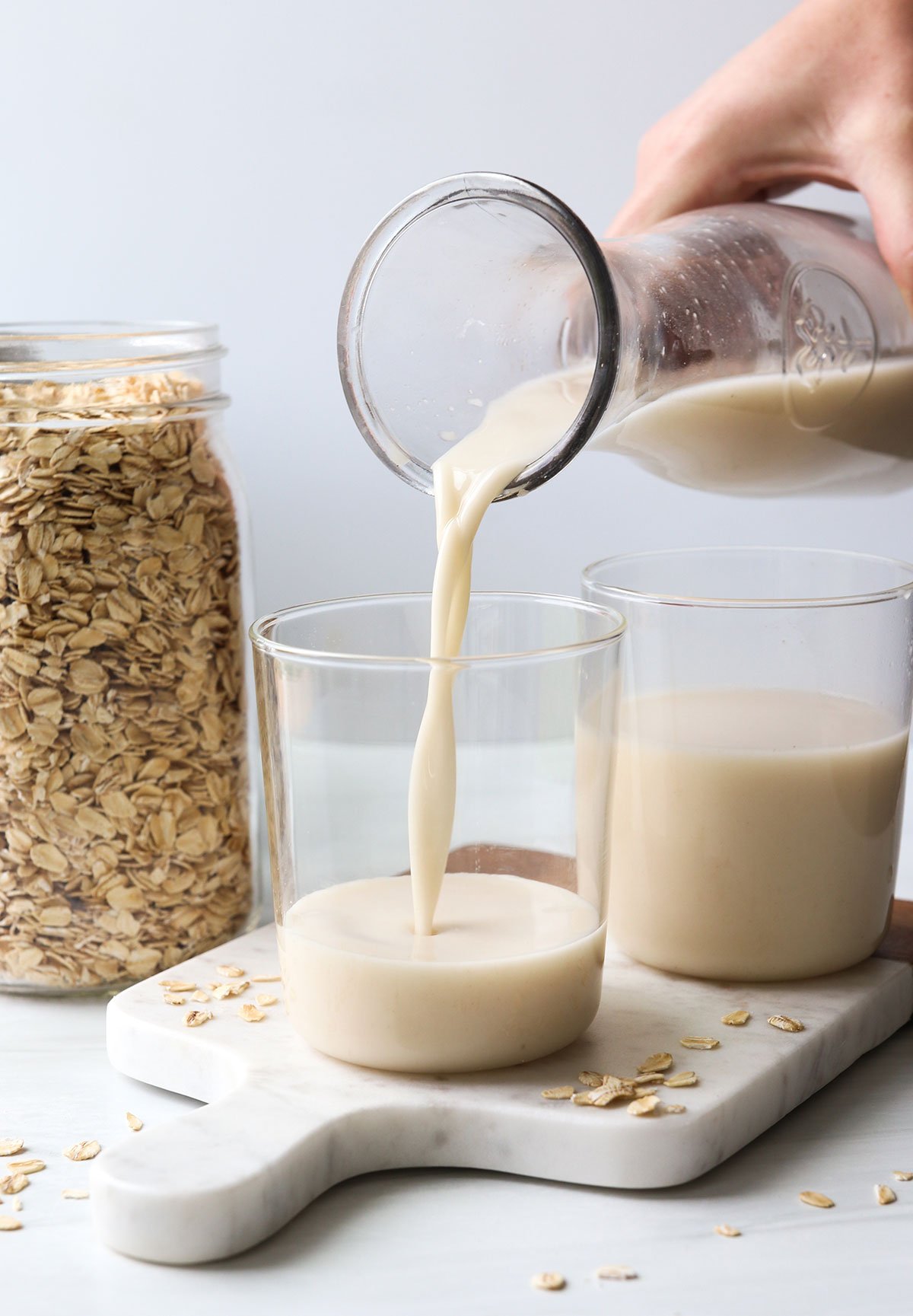
If you’ve been disappointed by homemade oat milk before, I hope you won’t give up until you try this method. I’ve spent the past two weeks testing several popular methods to help us all avoid a slimy consistency, while also making the milk as creamy as possible.
The good news is that this method doesn’t require special equipment, like a nut milk bag. (That creates slimier milk, so save that for making homemade almond milk instead.)
Best of all, this recipe takes just minutes to prepare and can be used immediately in coffee, smoothies, over cereal, or for baking.
⭐⭐⭐⭐⭐ Featured Review
“I have tried at least half a dozen different recipes but yours is by far the best…. you have explained ‘why’ you add each ingredient, which I feel is important. So, thank you!” -Paul
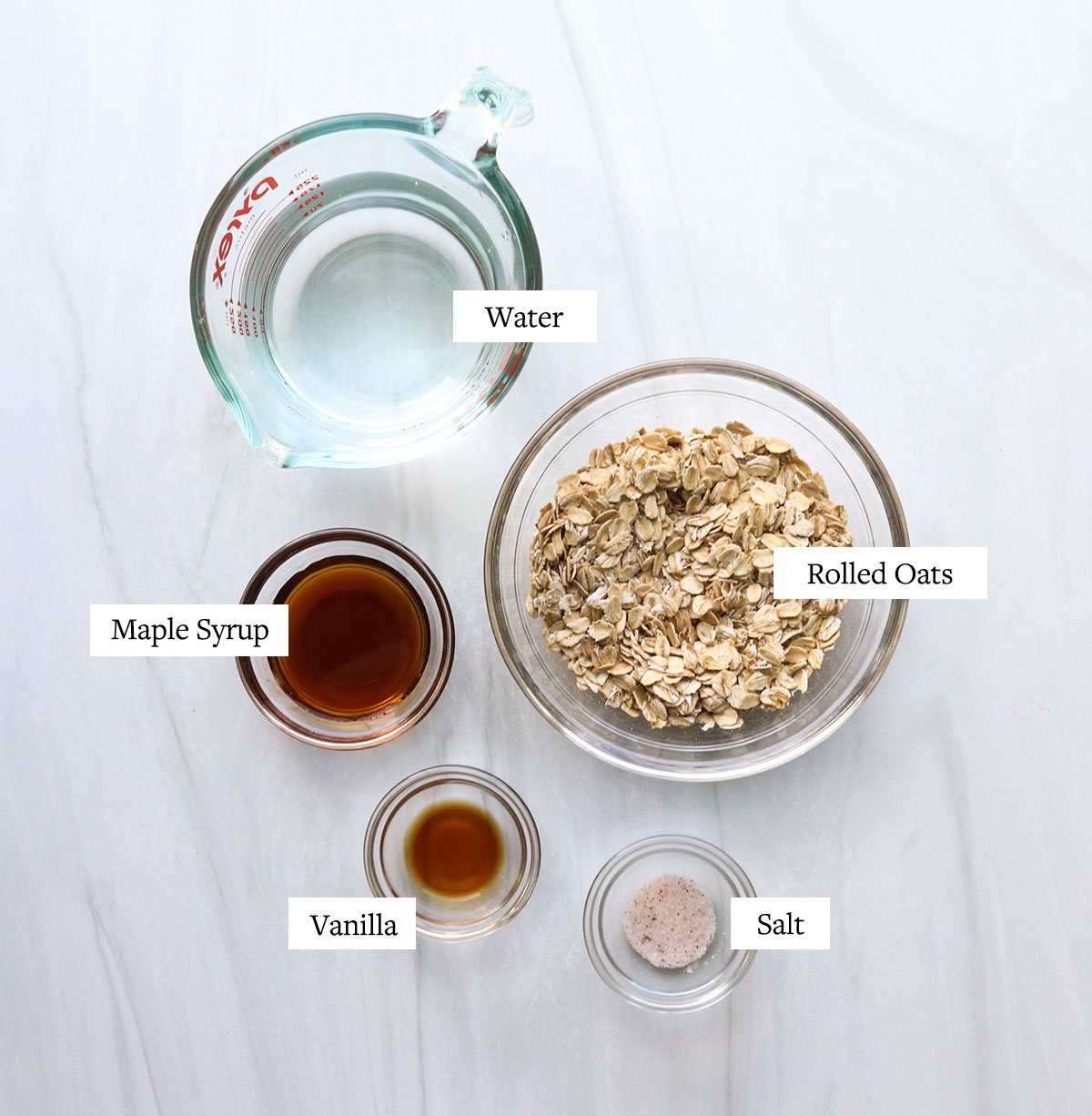
Homemade Oat Milk Ingredients
- Rolled oats. I typically use old-fashioned rolled oats, but quick-cooking oats can also be used as an alternative. If you need a gluten-free recipe, be sure to buy certified gluten-free oats to avoid any cross-contamination during processing.
- Water. I use a 6:1 water-to-oats ratio when making homemade oat milk. For a creamier consistency, you can use more oats. Just keep in mind that the more oats you use, the more slimy the oat milk can turn out. It’s a balancing act!
- Maple syrup. This adds a touch of sweetness and reminds me of Elmhurst’s oat milk. It’s optional, but it seems to help slightly with consistency as well.
- Vanilla extract. You can omit this if you want to make unsweetened oat milk, but I like the subtle flavor addition.
- Salt. A pinch of salt helps boost the flavor, but you can omit it if you prefer.
How to Make Oat Milk
Step 1:
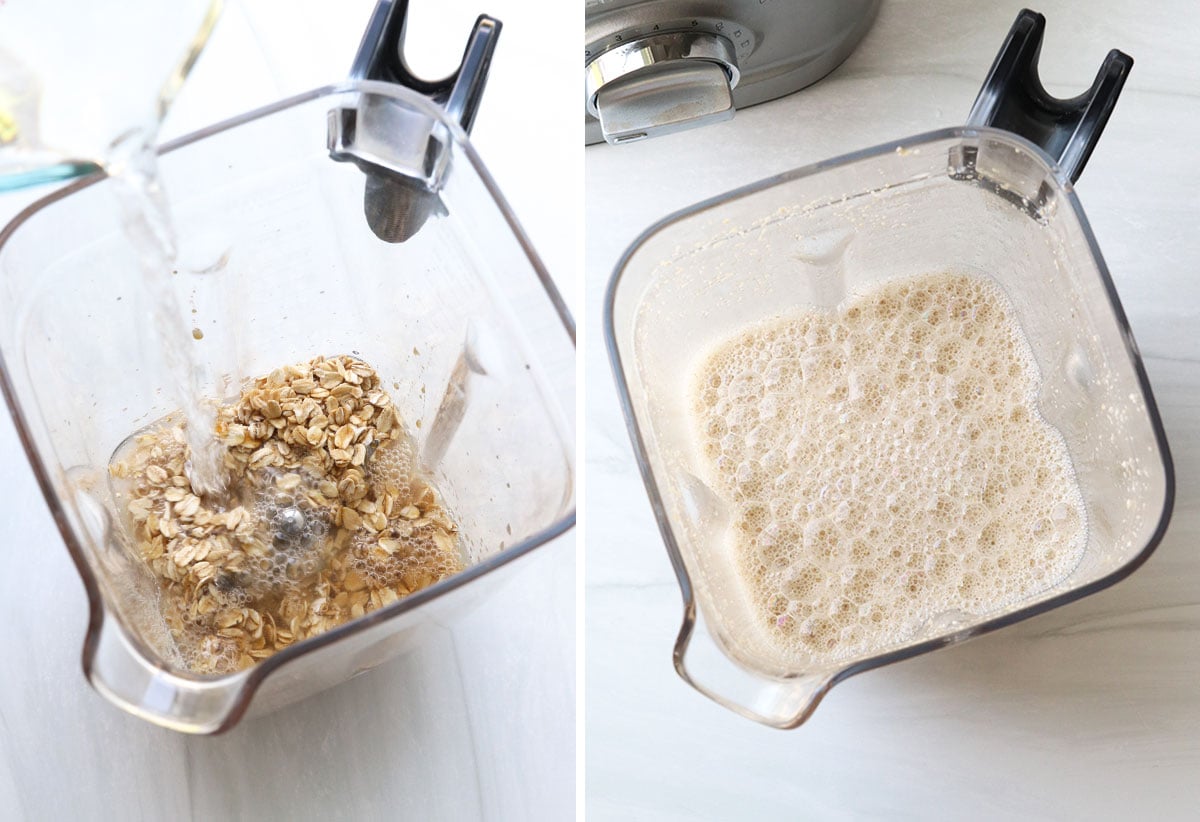
Combine the oats, maple syrup, vanilla, salt, and water in a high-speed blender and blend briefly until the mixture appears creamy.
Note: Don’t blend for more than 30 seconds in a high-speed blender, or the mixture may heat up and become slimy.
Step 2:
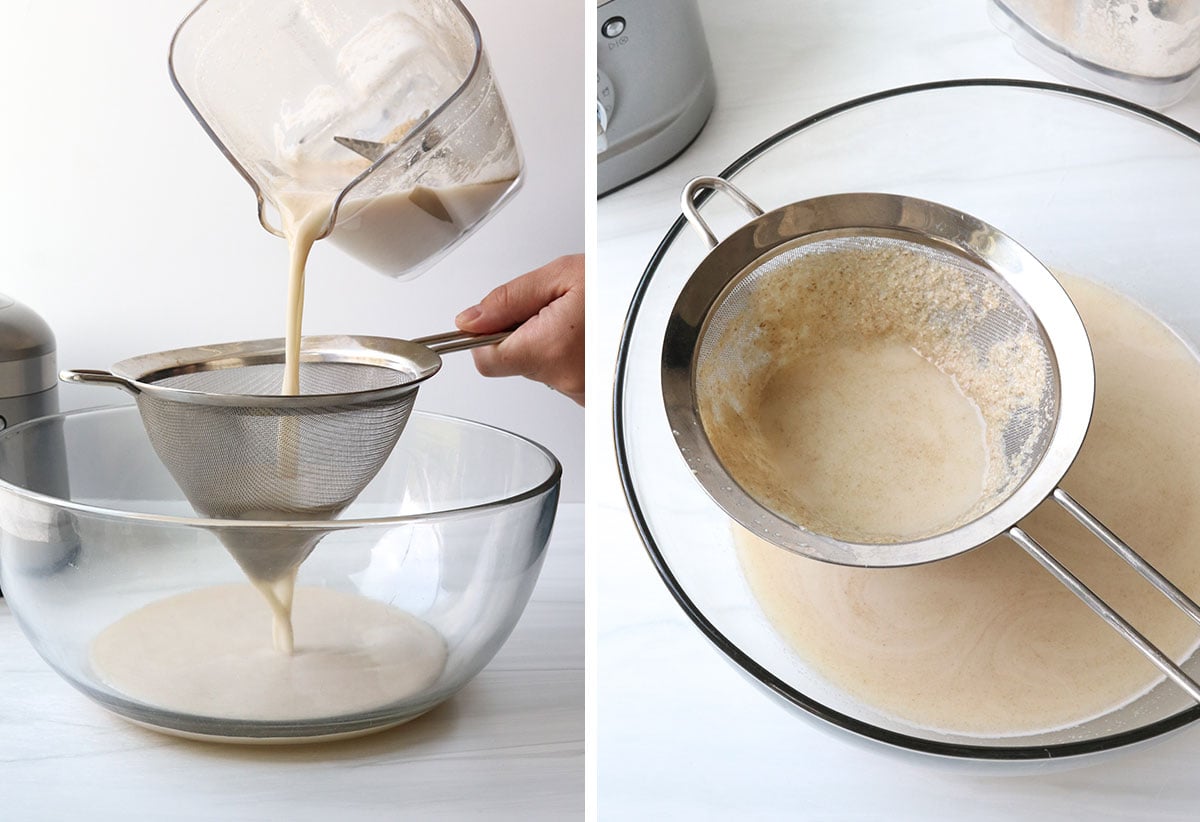
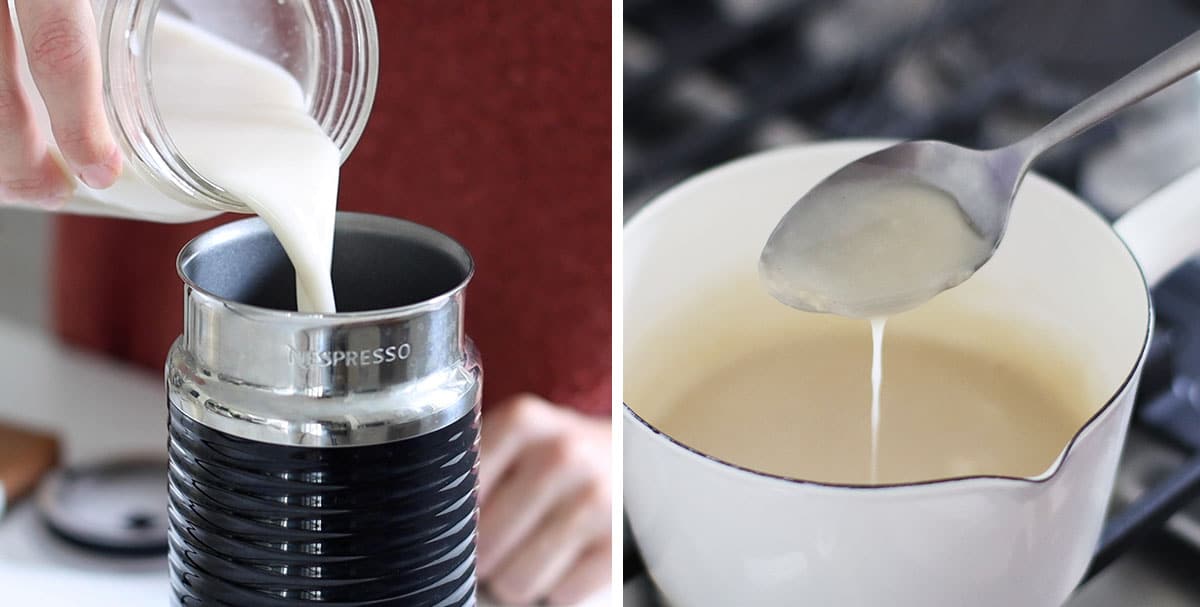
Arrange a fine mesh sieve over a large bowl and pour the blended oat mixture through it. This will separate the oat pulp from the liquid.
Do not squeeze or press the oat pulp to remove excess liquid, as this will make the oat milk slimy. (This is why I don’t recommend using a cheesecloth or nut milk bag, as you might be tempted to wring out the excess liquid.)
Save the oat pulp, if you like, or add it to your compost. It doesn’t have a particularly appealing texture, but you can add it to your morning oatmeal to reduce waste.
Step 3:
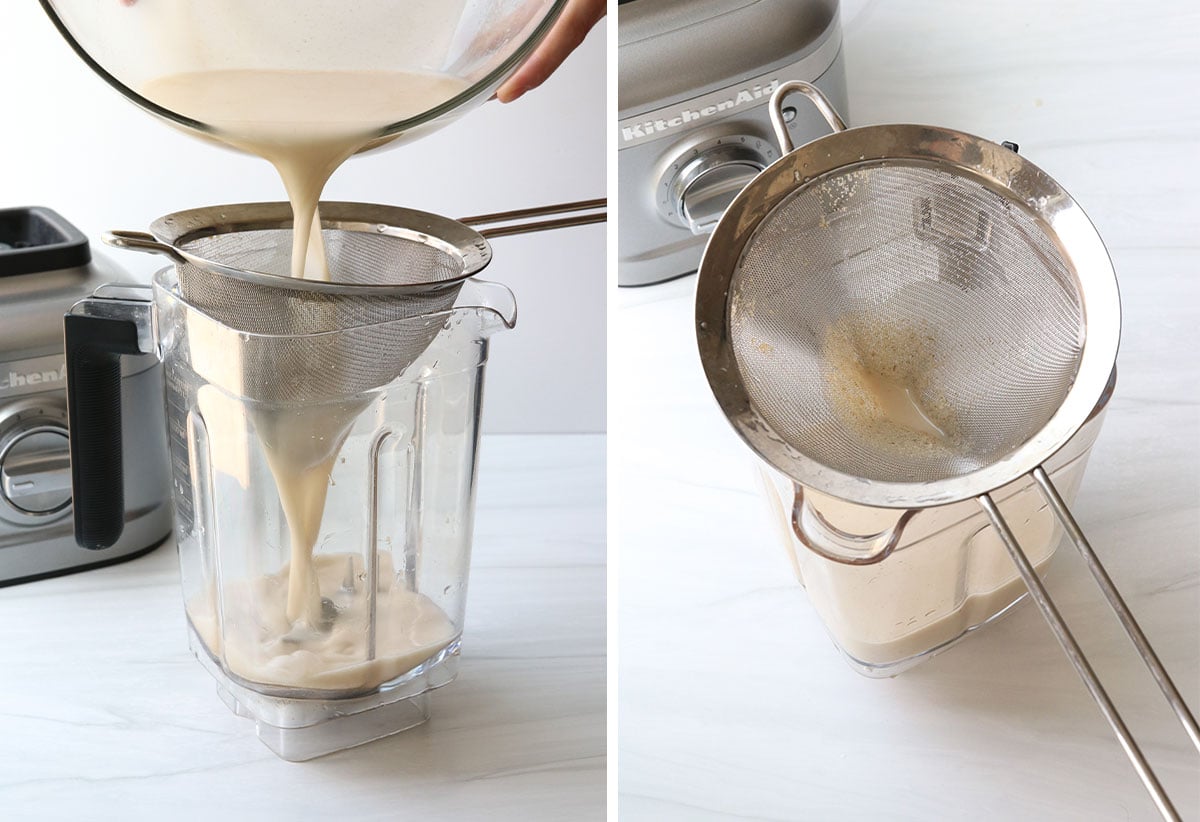
Pour the strained oat milk through the cleaned fine mesh strainer one more time to ensure you’ve removed as much sediment as possible. (The more pulp left in your oat milk, the more slimy it will be later.)
Double-straining the oat milk will give you the best consistency. It’s ready to use right away after that!
How to Use Oat Milk
Homemade oat milk can be used right away for:
- Cereal. Pour this milk over cereal, overnight oats, granola, and more.
- Smoothies. Use homemade oat milk as a creamy base for your favorite smoothie recipe.
- Creamer. Add chilled oat milk to your morning coffee or tea. It works especially well in iced coffee, as homemade oat milk can become slimy when heated.
Store leftover oat milk in the fridge for up to 4 days. Separation is normal when you store homemade dairy-free milk, so be sure to shake well before using it again.
How to Make Oat Milk Not Slimy
Oats contain a type of soluble fiber called beta-glucan, which can create a slimy texture when combined with water. This means oat milk is also prone to becoming slimy. Given this, research suggests that cooking oats or adding a digestive enzyme with amylase might help reduce the starch that contributes to the slimy texture.
I tried both methods and added oil to the mix to create oat milk more similar to the Oatly brand you’d buy at the store. Check out the results below!
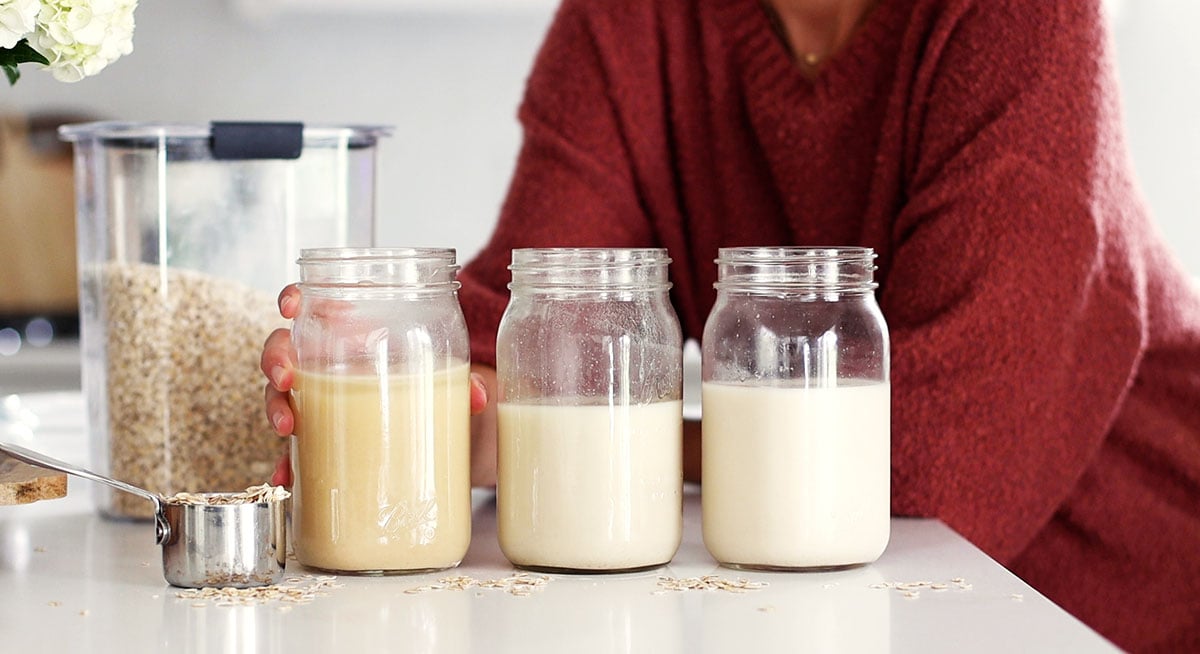
- Test #1: Soaking oats with digestive enzymes.
The logic behind this method is that the enzyme amylase naturally digests some of the starch in oats. In theory, this should help reduce the slime factor when the mixture is blended later.
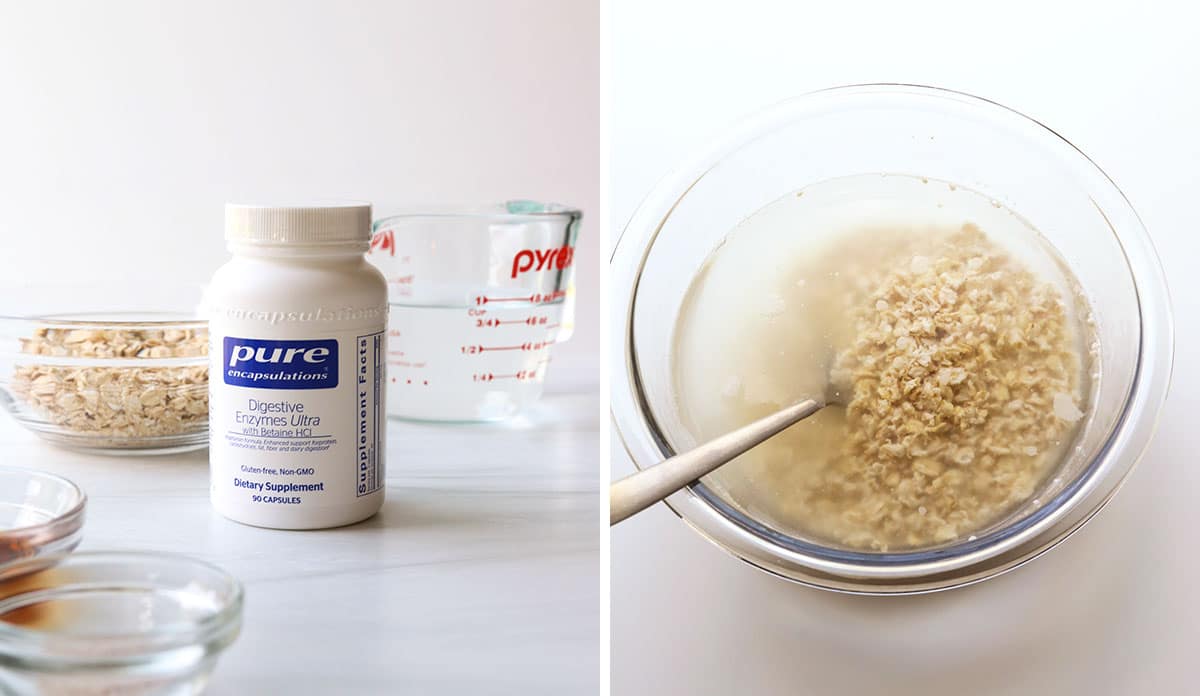
I tested this method two times. First, I used a super enzyme tablet dissolved in water, which reached 150°F. (The warm water, in theory, should speed up the enzyme activity, without killing it. Don’t use boiling water!) Then I added the oats to the warm water with the enzymes and let them soak for 40 minutes.
After soaking, the water tasted bad. It was bitter, and that flavor transferred to the oats as well. I thought adding maple syrup to the mixture might help balance out the bitterness, but it didn’t.
Despite the unpleasant flavor, I went ahead and tested this oat milk by heating it up on the stovetop. It thickened up as if I hadn’t added the enzymes at all, which was super disappointing and a waste of my time and ingredients.
To make sure it wasn’t user error, I tested this method again with a different digestive enzyme that contains both amylase and glucoamylase. I emptied a capsule into warm water (150ºF) and added the oats to soak for 40 minutes. This time, the results were MUCH better!
The soaked oat water didn’t taste bitter, and when I blended the oats with their soaking water, the results were creamy and tasted great. It can also be heated without thickening if this is your goal. Ultimately, almond milk still creates a much better option for lattes (oat milk doesn’t create a thick foam), but this oat milk variation can be warmed up successfully.
Conclusion: This method added 45 minutes to the overall preparation time, as well as the additional expense of purchasing digestive enzymes. However, it does work, with one caveat. The correct enzymes significantly reduced the slime factor and prevented the oat milk from thickening when heated.
However, the added enzymes will continue to work as the oat milk is stored in the fridge, so the flavor is not as delicious the next day. Bringing the oat milk to a boil before storing it in the fridge should help stop enzyme activity, but that is another added step that makes this method less appealing overall (to me, at least).
- Test #2: Toasting the oats.
Research suggests that toasting oats can break down the starches they contain. The logic behind this method is that toasting the oats before blending them may reduce some of the slime created by the naturally occurring starches in oats.
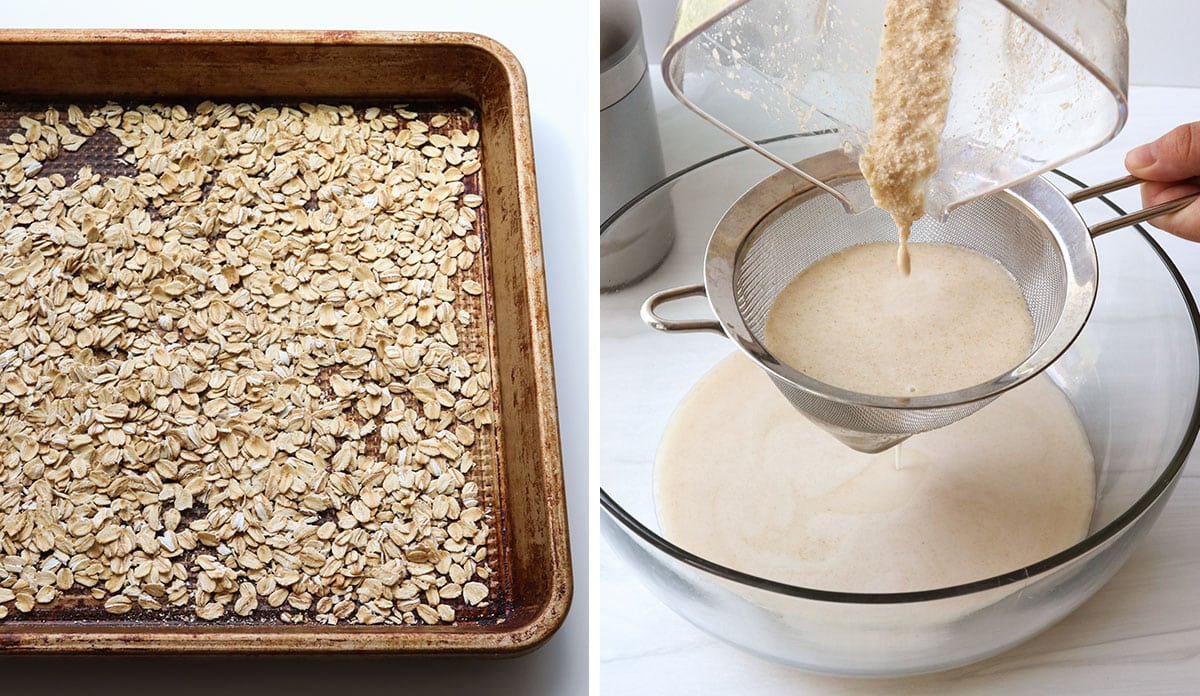
To test this, I spread dry rolled oats on a baking sheet and toasted them at 250ºF until they were lightly golden, about 1 hour. Next, I prepared the oat milk recipe as directed above.
Conclusion: Toasted oats create a slightly more tan-colored oat milk that is more grainy in texture, even with a high-speed blender. There is definitely no slimy texture in this case, and it did not thicken when heated. However, it lacks creaminess and doesn’t have a satisfying mouthfeel, so I don’t recommend this method for making a creamy non-dairy milk.
- Test #3: Adding oil.
Popular store-bought brands often add oil to non-dairy milk to improve its texture. In this case, I wanted to see if adding expeller-pressed coconut oil would help improve the texture of the oat milk. (Refined coconut oil adds zero flavor, but another mild-flavored oil could be used. Just make sure you enjoy the taste, since it might be noticed in your milk.)
I tested this method two ways. First, I added a tablespoon of coconut oil to the liquid ingredients of this recipe and blended until the coconut oil dissolved in the water. It became chunky at first, but eventually dissolved as the water warmed up from blending. Then, I added in the oats last so they wouldn’t be over-blended.
In this case, the oat milk didn’t act any differently than the oat milk made without oil. It still thickened when heated and did not create any foam for a latte.
The second way I tested this method was by adding a 1/2 teaspoon of coconut oil to an already prepared oat milk, as directed above. I wanted to see if the oil would give the oat milk a better texture for coffee, so I heated it in my electric milk frother. The coconut oil did not add any flavor to the oat milk, and it also did not help create foam. It didn’t appear to be any different in texture when compared to the oil-free version.
Conclusion: Adding oil to oat milk doesn’t seem to improve its texture when heated.
Ultimately, none of the options above felt “worth it” when compared to the simple 5-minute method of blending oats and gently straining them. I hope reading about these experiments will save you some time & effort!
Oat Milk Recipe (Fast & Non-Slimy!)
Ingredients
- 3 cups water
- ½ cup old fashioned rolled oats (certified gluten-free, if needed)
- 1 tablespoon maple syrup
- ½ teaspoon vanilla extract
- pinch of salt
Instructions
- Add the water, oats, maple syrup, vanilla, and salt to a high-speed blender and blend briefly, about 20 to 30 seconds, until the mixture looks creamy. Do NOT over-blend, as this will make the consistency more slimy.
- Pour the blended mixture through a fine-mesh strainer, and tap the sides of the strainer to make sure the liquid strains through. (Don't use a spoon to press the pulp into the sides of the strainer, or the resulting milk will be slimy. This is also why you also don't want to squeeze through a nut milk bag for straining.)
- For an extra-smooth milk, rinse off the strainer and then pour the milk through it a second time. This will strain out any extra sediment for an super-smooth oat milk.
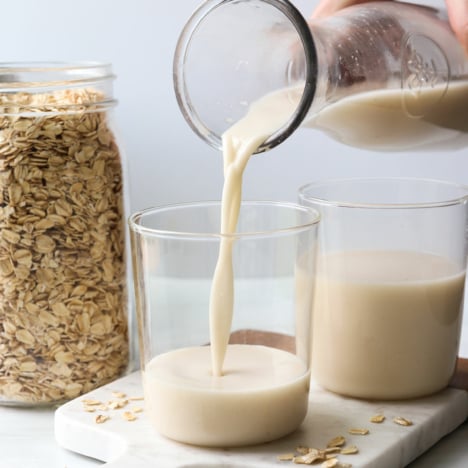
- Use the milk right away, or store it in an airtight container in the fridge for up to 4 days. This homemade milk will separate when stored, so shake it again before using.
Video
Notes
Nutrition
More Recipes to Try
If you try this oat milk recipe, I’d love to hear what you think! Please leave a comment and star rating below to let me know how it worked for you.







Hi. I’m wondering if a cheesecloth will do the job, because that’s a bit different from a nut milk bag? Or will it just make the milk just as slimy?
I think of cheesecloth as having a similar mesh texture to the nut milk bag, so my guess is that it would make it slimy. You don’t want to squeeze or press any of the milk out, so if you can make it simply “strain” through the cheesecloth without squeezing or pressing, that could work.
Thank you for this recipe, what a great alternative to buying almond milk! I have a question.When I make this, the liquid flows through my strainer so quick I am not sure that it’s actually correct. Can you let me know, is it supposed to linger longer? Possibly my strainer is not fine enough? Thank you!
It may be that your strainer isn’t fine enough. I find that mine gets clogged during this process, so I usually can only do half the batch, then rinse the strainer, and then strain the rest.
Hi megan! I love your recipes! Quick question: with the oat milk have you tried using any other oil than coconut oil? I can’t eat saturated fats. Would avocado oil ruin the taste? I’d love your ideas. Thanks!
If you like the taste of avocado oil, go ahead and try it! You’ll mildly taste whatever oil you use, but I think any added fat should work for use as a coffee creamer.
Love this recipe!
Suggestion for the pulp – Banana Oat Pancakes. Simply add a ripe banana, 2 eggs, tsp vanilla essence and a pinch of salt and blend. Sprinkle pancakes with cinnamon, add a dollop of natural yogurt, top with a few, berries and a drizzle of maple syrup … yum!!
PS – note to Kristie re Coconut oil -if you are avoiding saturated fats due to ” high cholesterol, you should know that the fatty acid chains in coconut oil are unique and actually help boost HDL (or “good”) cholesterol to ward off heart disease and lower high triglycerides. Studies also show that coconut oil helps to improve brain function and is even recommended for people with Alzheimer’s … so its a shame that people are afraid of using this remarkable oil. Just worth doing a little research before writing it off completely 🙂 .
Julie,
There is a lot of controversy around the claim that the medium-chain saturated fat in coconut oil (which is about 80% saturated fat) is not harmful to heart health or even improves it.
Here’s a good summary from Healthline:
***********
Superfood or Poison? Here’s What the Experts Say About Coconut Oil
Breaking down the coconut oil controversy.
Is coconut oil “pure poison”?
Last month, a doctor from one of the country’s leading health institutions sparked a tsunami of debate on the oil’s health benefits by uttering those words.
Karin Michels, PhD, ScD, professor at the Harvard TH Chan School of Public Health and director of the Institute for Prevention and Tumour Epidemiology at the University of Freiburg in Germany, made the declaration at a conference in late August. Her speech quickly went viral and the backlash was fierce and pointed, particularly on Twitter.
The hashtag #coconutoilcontroversy quickly sprouted up with many people tweeting about the benefits of coconut oil, while disparaging the doctor for making such a blanket statement.
The long history of coconut oil
The general argument in favor of coconut oil is that it’s been used for centuries in Southeast Asian countries without detriment to those cultures. Many took offense that a Western doctor was imposing her beliefs on a product that non-Western countries have used for decades.
It’s true that coconut oil is a staple cooking ingredient in India, the Philippines, and Indonesia. In India, the oil is also popular for hair and skin care regiments.
What’s changed though, is that in the past five years or so, people in the United States and other areas of the Western world have come to embrace the use of coconut oil with a fervent passion. So much so that coconut oil has moved into the rarefied world of “health-halo” status.
Meaning, its health benefits tend to be viewed as a cure for a host of ills.
So, is it superfood or poison?
Melissa Majumdar, RD, is the senior bariatric dietitian at Brigham and Women’s Center for Metabolic and Bariatric Surgery. She is also a spokesperson for the Academy of Nutrition and Dietetics. She told Healthline that coconut oil isn’t poison, but it also doesn’t deserve superfood status either.
“I don’t like to call food good or bad, let alone poison,” she said, “but coconut oil is not the saving grace that we think it is.”
Coconut oil is derived from the white flesh of the tropical fruit. Once pressed, the oil can last up to six months without spoiling. That’s because it holds a low oxidation rate and therefore doesn’t become rancid as quickly as other oils.
Coconut oil is high in saturated fats, about 80 percent. Red meat contains 50 percent saturated fat, while butter holds about 65 percent of saturated fat.
Studies have shown that consuming too much saturated fats can cause to rise in the blood stream. This is the bad fat that can ultimate lead to hypertension, cardiovascular disease, and heart disease.
How did a highly saturated fat such as coconut oil transition to superfood status?
According to a story from Business Insider, the buzz about coconut oil stems from a studyTrusted Source published in 2003 on the health benefits of medium-chain triglycerides. The report showed that these types of fatty acids can help people boost their metabolism.
It appears food bloggers and influencers, and food marketers caught wind of the report and extrapolated that information on to coconut oil — which also contains medium-chain triglycerides.
But according to Majumdar, people may not be aware that medium-chain triglycerides only make up about 14 percent of coconut oil. The rest are long-chain triglycerides — the ones that can cause heart disease.
What’s more, the author of the medium-chain fatty acid study told Time magazine that her report was done with so-called designer oil, which contained 100 percent medium-chain triglycerides (fatty acids). The study found that a person would need to consume 15 to 20 grams of the designer oil to boost their metabolism, according to the magazine.
Other studies have tried to answer this ongoing public debate about the benefits of coconut oil, but so far, research hasn’t provided a clear answer. A 2016 meta-analysisTrusted Source of coconut oil research published in Nutrition Reviews looked at 21 studies. The report said there aren’t enough well-designed studies yet for any real meaningful conclusions to be determined.
“Coconut oil generally raised total and low-density lipoprotein cholesterol to a greater extent than cis unsaturated plant oils, but to a lesser extent than butter. The effect of coconut consumption on the ratio of total cholesterol to high-density lipoprotein cholesterol was often not examined… Given the limited number of intervention studies in this area, along with the methodological flaws evident in existing studies, further well-designed randomized trials that include appropriate controls, are adequately powered, and examine a range of CVD risk factors are required,” according to the report.
Majumdar said despite inconclusive evidence, the health benefits of coconut oil continue to linger in the public’s collective mind. A New York Times survey showed that 72 percent of the public view coconut oil as healthy, compared to just 37 percent of nutritionists.
She noted that people also believe that coconut can help cure diabetes, Crohn’s disease, and irritable bowel syndrome, among many others.
Majumdar said it’s challenging to fight the healthy narrative that now defines coconut oil. She doesn’t want to make people afraid of food, but she’s committed to making sure the public has the correct information about the oil.
Her main takeaway is that people should keep their saturated fat intake to less than 10 percent of total calories consumed, which includes coconut oil.
“It needs to be put into perspective,” she said.
*************
Here’s some more good cholestererol and oat information from the Harvard Medical School website:
Cholesterol
Cholesterol isn’t entirely the health villain it’s made out to be, its name darkly linked to heart attack, stroke, and other types of cardiovascular disease. Our bodies need cholesterol, which is a type of lipid (another name for fat) to make cell membranes, key hormones like testosterone and estrogen, the bile acids needed to digest and absorb fats, and vitamin D. Cholesterol is so important to the body that the liver and intestines make it from scratch.
What is “bad” about cholesterol isn’t the substance itself — in fact, we can’t live without it — but how much of it is in the bloodstream.
The body packages cholesterol in two main particles: low-density lipoprotein (LDL), the so-called bad cholesterol, and high-density lipoprotein (HDL), the so-called good cholesterol. Too much LDL in the bloodstream helps create the harmful cholesterol-filled plaques that grow inside arteries. Such plaques are responsible for angina (chest pain with exertion or stress), heart attacks, and most types of stroke.
What causes a person’s LDL level to be high? Most of the time diet is the key culprit. Eating foods rich in saturated fats, trans fats, and easily digested carbohydrates boost LDL. Genes are sometimes at the root of high cholesterol, and some medications can boost LDL.
If you have high cholesterol, making changes in your diet can help bring it down into the healthy range. Exercise can help boost the level of protective HDL. Several types of medication, notably the family of drugs known as statins, can powerfully lower LDL. Depending on your cardiovascular health, your doctor may recommend taking a statin.
Also this:
“Grain of the month: Oats
“Oats, which are high in soluble fiber, appear to be the most effective grain for lowering cholesterol…”
How interesting! We drink a lot of oat milk in Colombia, and it’s slimy. In fact, that’s my favorite aspect of it!
What if you just have a regular glass oster blender? Is it not powerful enough?
In this case, the worry is about over-blending, so a normal blender should work just fine! Just blend until it looks creamy.
This worked great for me. Much cheaper than buying it at the store. This recipe is going to be my new go-to.
Just made it this morning and it turned out awesome. I did your coffee creamer trick with the added coconut oil, and it worked great! It’s a little thinner than regular cream, but I’m trying to avoid dairy and I love that I can bring this to work with me without worrying about nut allergies. (I’m a school teacher, so we have to be nut-free in the classroom.)
Hi Naomi! I too am trying to reduce my dairy intake for better health and am hoping to try this recipe in my daily coffee creamer alternative.
Can I ask how much coconut oil you used in your blend? And do you add it right away? Or do you add it when you are making your coffee? Any helpful tips you can share for the “coffee creamer” aspects of this oat milk would be great!
You did it!! Thank you for sharing your method, because every other recipe I’ve tried online makes slimy milk. I figured I must be doing something wrong, but I think you’re right, soaking the oats first makes them slimy. I like how you use less oats than other recipes I’ve seen, too. This turned out perfectly.
Have you used the oat pulp in any recipes? I’m alway curious how to use up the pulps so 8 don’t waste any food. Thanks!
I think the only thing I’d save it for is to add to smoothies. The pulp is pretty slimy and hard to work with, and you’ll only wind up with maybe 1/4 cup or less after scraping it out of the strainer, so I’d just throw it in the freezer to save for a smoothie. (Or maybe you could add it to a bowl of oatmeal later?)
I agree with Jessica that this is the best oat milk recipe available. I also had nothing but slimy results with soaking rolled oats beforehand. I even tried re-straining the milk after it was in the fridge awhile (not as slimy but still?!)
(Tayler) I use the leftover pulp & the slimy residue to make dog & people food/treats (mix the pulp w/PB or whatever suits your taste & freeze for doggie popsicles, mix in muffins, add to a favorite dish)…the slimy residue is great for thickening sauces, etc…just save it in a jar or freeze as suggested. It doesn’t affect the taste of most things either. You’d be surprised at what you can actually do with it!
Dogs are NOT suppose to eat oats! or grains. they are carnivores! oats will eventually give health problems.talk to you’re vet.
Cats are carnivores. Dogs are omnivores.Dogs are also able to digest starch and oatmeal is not a bad grain for them overall.
My beloved greyhound DIED of the so-called “grain-free diet” fad in dogs. Dogs have evolved for over 40,000 years to eat human SCRAPS – which means grains. Dogs CAN eat oats, just like humans can. Please for the love do your research on actual websites not social media, look at PubMed and other sites for true data. 99% of dogs should not be on grain-free food. Dogs are not wolves either, they are hundreds of thousands of “generations” removed from them, so they don’t need to eat or live like them.
Our vet actually specifically warned us against grain free diet.Many dogs have health issues because of all the grain free dog food out there now. Also, dogs don’t need meat to be healthy. So please do your research using reliable sources before posting comments completely unrelated to subject of this blog.
Umm – dogs are actually omnivores, like humans, and grains are NOT bad for them. Cats, on the other hand, are obligate carnivores, so they have to have meat in their diet. This whole grain-free dog food trend is just silly anthropomorphizing. Yes, please DO talk to your vet about it. I’m sure he (or she) is a more knowledgeable animal nutritionist, having spent four years studying the subject in VET SCHOOL… I have more than a passing knowledge from my thirty-plus years as a veterinary technician.
When we got a cat my dog got very jealous and only wanted to eat the same food as her. We Complied until he started having health problems. Luckily we caught it in time and took him to the Vet who specifically told us he needed more grains and roughage
dogs are omnivores
My two pugs are fed a vegan dog food/diet and our vet says they’re the healthiest pugs he’s seen in all of his years of practice. Absolutely no health problems and they’ve been vegan for about 8 years.
Dogs ARE NOT OBLIGATE CARNIVORES
This is a great idea! I just made some in ice trays. I’m sure doggies will love it.
The pulp makes for a great body and face scrub for kids and cures itchiness.I preserve mine in a bottle with a few drops of lemon.You can safely use it for 2-3 days.
I add the oat pulp to a regular pot of oatmeal. I can’t even tell it’s in there, and I believe it’s still nutritious. You don’t blend the heck out of it like you do with almond or coconut milk (where you squeeze every little bit out and you’re left with pure fiber). There should still be plenty vitamins and minerals, and that “slime” is soluble fiber that’s actually good for us!
We put the left-over oats in pancake mix. Adds some body and fiber!
How do you adjust the pancake mix ingredients when you add the oat pulp?
You can also add the pulp to a bath for a soothing, moisturizing oatmeal bath. If you don’t want all the pulp floating around in the bath then just wrap it up in some cheesecloth
I’VE BEEN MAKING DOG TREATS USING THE PULP LEFT OVER FROM HOMEMADE ALMOND MILK. I PLAN ON USING THE PULP LEFT OVER FROM MAKING OAT MILK AS WELL. I THINK IT WILL WORK SINCE I ALREADY USE OATS IN THE RECIPE. FOR THE DOG TREATS 🙂
this is going to sound stupid, but what about oat flour…oats are oats right?
Yes, oat flour is just ground oats, so I think that should work the same. Just keep in mind that you don’t want to over-blend this to avoid the “slime” factor, so the oat flour might need even less blending time.