

This post may contain affiliate links. Please read my disclosure and privacy policy.

If you enjoy baking with almond flour as much as I do, you might find yourself in a situation where you want or need to make it at home. It could save you an extra trip to the grocery store or help you use up some extra almonds in your pantry!
Making homemade almond flour is easy, but I’ve recently discovered a new trick for achieving a texture more similar to the finely ground store-bought variety. (Hint: It involves the fine mesh strainer I use almost every day.)
I’ll also show you how to use almond flour as a substitute for all-purpose flour, along with a few trusted recipes to help you get started.
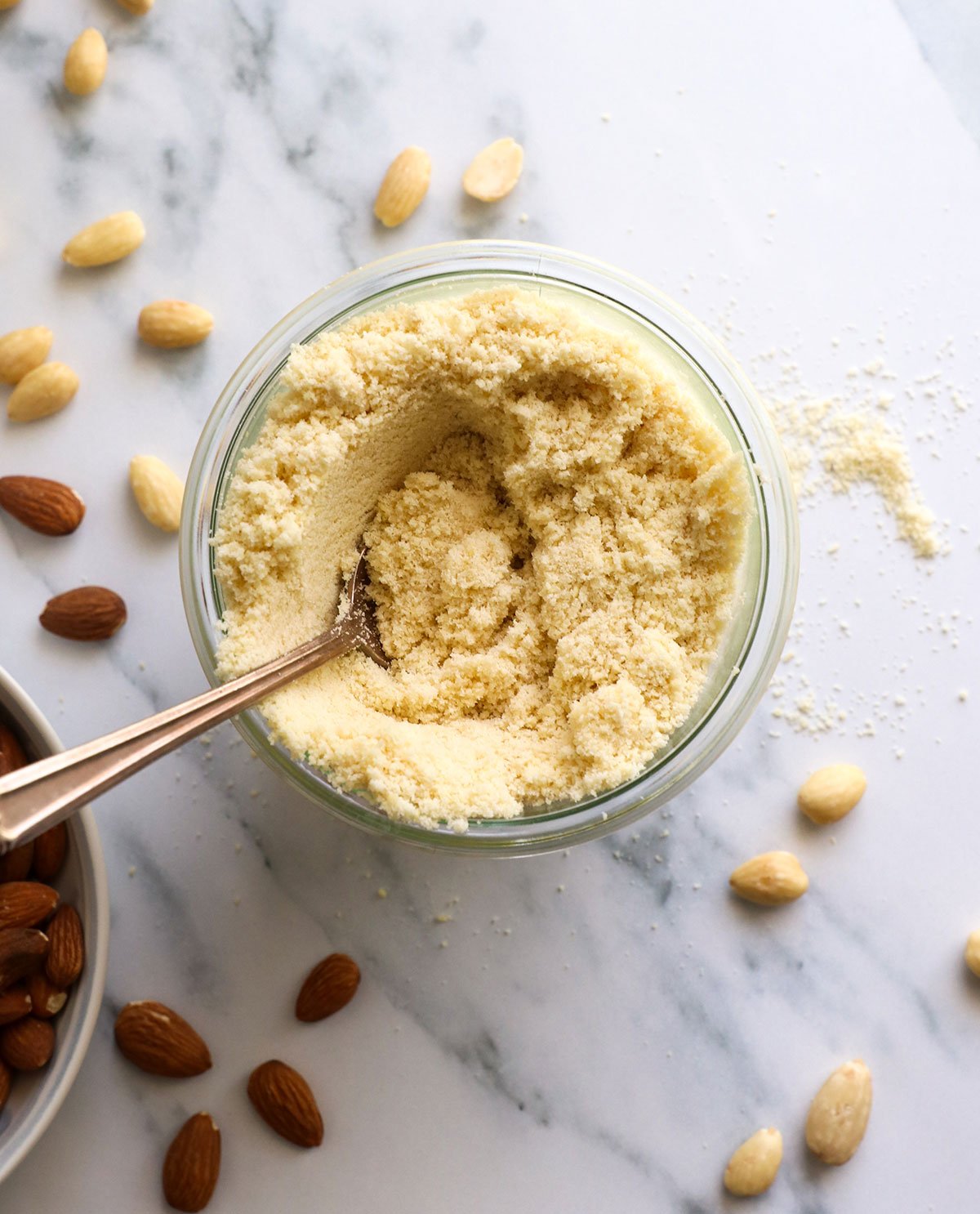
Ingredients for Almond Flour
The only ingredient in almond flour is, not surprisingly, almonds.
- Blanched Almonds. When you buy almond flour at the store, it’s likely made with blanched almonds, which means their skins have been removed first. Using blanched almonds will yield a finely ground flour that produces fluffier cakes and muffins, as well as cookies with a more buttery texture. Blanched almond flour, in general, will give you the best results in baking.
- Whole Almonds. If you use whole almonds to make flour, you’ll be making almond meal instead. Almond meal produces baked goods that are softer and more moist, so the results will be different than using blanched almonds.

How to Make Almond Flour
Step 1:
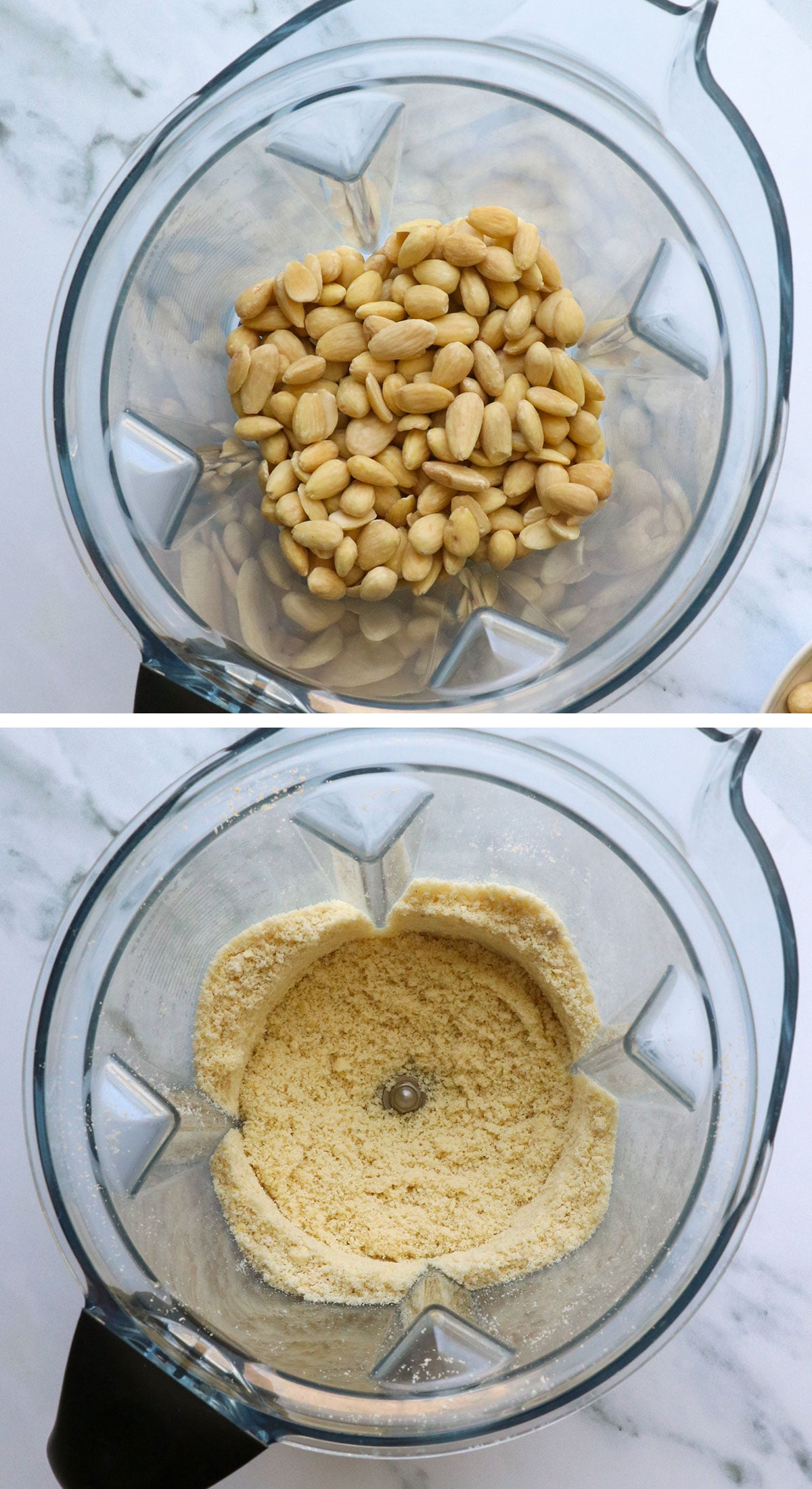
In a food processor or high-speed blender, add 8 ounces of almonds. This is about 1 1/2 cups of whole almonds if you don’t own a food scale, and will produce about 2 cups of almond flour when you’re done processing it. (Because it gets fluffier.)
Secure the lid and process for about 30 seconds. Stop and scrape down the sides of the machine, then pulse the almonds again.
After about 60 seconds, the almonds should appear finely ground.
Step 2:
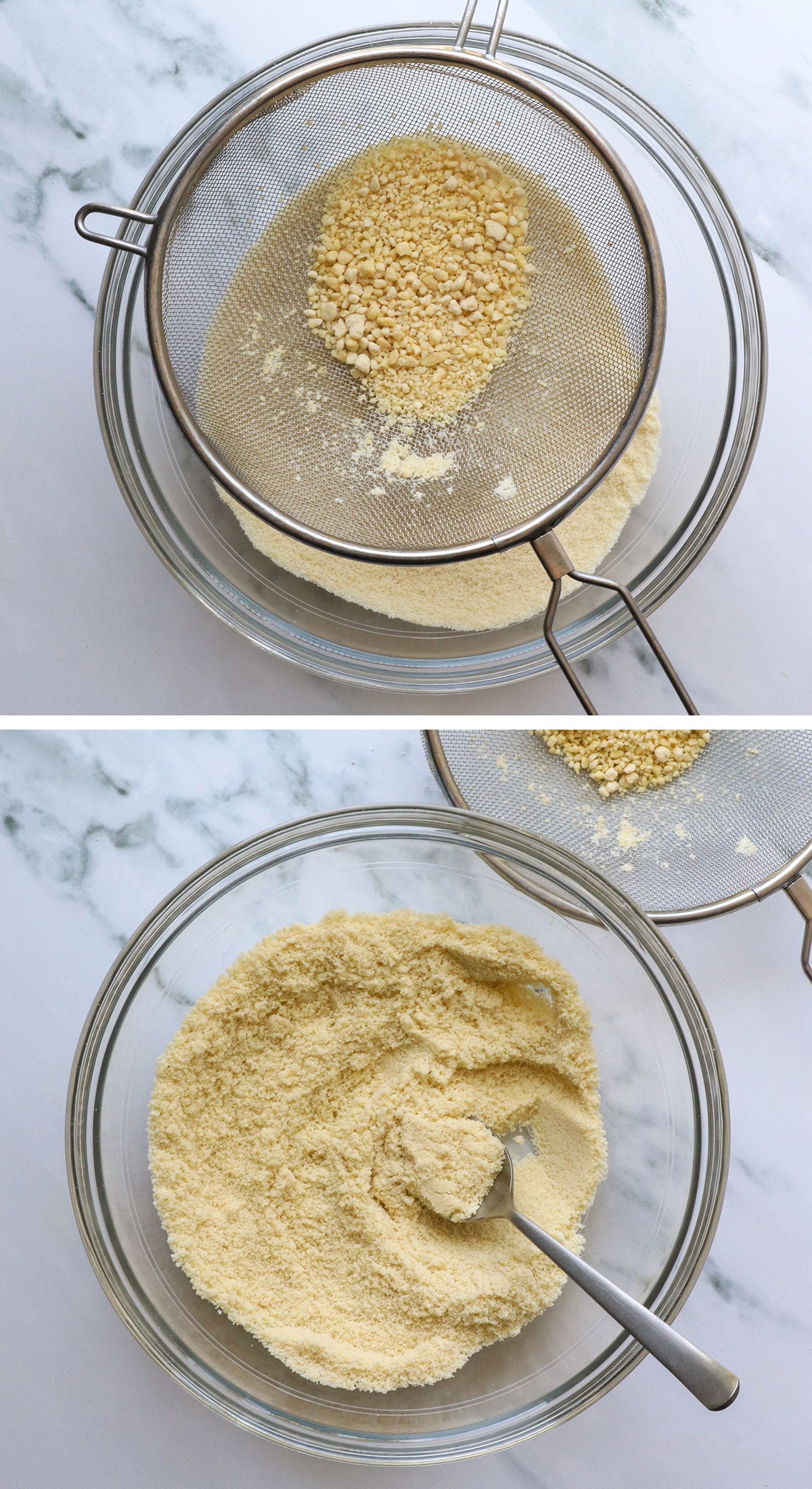
No matter which machine you use, you’ll likely have a few almond pieces that were missed. You can filter these out by pouring the flour through a fine mesh strainer arranged over a large bowl.
Shake the strainer, like you’re sifting the flour, until only larger chunks of almonds are left in the strainer. In the bowl below, you should have finely ground almond flour, ready to use in recipes.
You can return the larger almond pieces to the machine and attempt to process them again, or just save them separately to add to a recipe when you want a little added texture. (Such as salads, quick breads, or granola.)
Almond Meal vs. Almond Flour
If a recipe calls for almond flour, it’s likely assuming that you’re using blanched almond flour, meaning the skins were removed from the almonds before they were ground finely.
Almond meal is another popular option made from whole almonds that have been finely ground. You can make this at home using the same method described above.
The main difference is that it’s not as easy to strain this variation. (Most of the almond meal would not fall through my fine mesh strainer, so I couldn’t make it as “fine” in texture as the blanched almond flour.
When using almond meal instead of almond flour, you may find that baked goods turn out denser and moister, rather than buttery, fluffy, or crisp around the edges.

How to Substitute Almond Flour for Regular Flour
Unfortunately, almond flour is not a 1:1 swap for all-purpose flour. This is likely because it contains more fat than grain-based flours.
I experimented with chocolate chip cookies and found that I needed to nearly double the flour a recipe called for when using almond flour. Therefore, it may be a safer bet to double the flour when using almond flour instead of all-purpose flour.
With that being said, it’s a better idea to look for a recipe that’s already been tested with almond flour. That way, there’s no guesswork for you!

Recipes for Almond Flour
Try one of these popular options to get started:
- Chocolate Chip Cookies
- Almond Flour Brownies
- Fluffy Almond Flour Cake
- Chocolate Almond Flour Cupcakes
- Almond Flour Pancakes

Ingredients
- 8 ounces blanched almonds , whole or slivered
Instructions
- Place the blanched almonds in a high-speed blender or food processor, and process until they are finely ground. If using a high-speed blender, be sure not to over-process as the almonds will eventually start to release their oils and become almond butter.
- For best results, do not blend more than 8 ounces of almonds at a time. (I tried using 16 ounces and couldn’t get them evenly ground.) For the most finely-ground results, I’ve found a blender works best, but the flour I made in the food processor also works for making almond flour recipes– the final product is just slightly grainier.
- For fine almond flour, pour the processed almonds into a fine mesh strainer arranged over a large bowl. Shake the strainer to sift the flour through the mesh. This will catch any large pieces the processing might have missed, leaving you with finely ground flour in the bowl. This flour is ready to use right away in your favorite almond flour recipes.
Notes
Nutrition
If you try this almond flour recipe, please leave a comment and star rating below to let me know how you like it.








Just made almond flour bread hope it turns out ok the flour alone was $10
It’s still in the oven xx
What can I use the ground almonds left over after I make almond milk? And, can this be used to make almond flour?
Search for “almond pulp” recipes on my website, and you’ll see a few options! My favorite is Almond Pulp Hummus, because you can use the wet pulp right away without drying it.
i found some almond flour on amazon that was 25 cents/ounce but the cheapest price for almonds is 47 cents/ounce. Doesn’t this make it cheaper just to buy the flour or am I missing something?
(I mean this in the most curious way possible. Just want my tone to come off right, I know it can be easy to read this as a cocky comment, but I promise I mean this in the nicest way possible)
If you can find almond flour for 25 cents an ounce right now, I would buy it! I originally wrote the post nearly 7 years ago, when almond flour was very expensive and more rare, and it seems to be getting cheaper by the month. So definitely shop around!
How does 8oz. of almonds equal 1lb. of flour? Volume does not equal weight. Your $0.50 savings actually equates to a higher cost per pound. What is math?
This post does not say that 8 oz. of almonds equals a pound of flour. I used an 8 oz. bag to calculate the cost per ounce. We are comparing price per ounce in this post, but you can multiply that by 16 to get the cost savings per pound.
I have store bought almond slivers, but have no clue if they are blanched or not. I no longer have the packaging. Is there a way to tell if they are blanched?
Blanched almonds have their skin removed, so the almonds are just white-looking.
Hi, just wondering if it matters if I use a coffee grinder mill instead of the Vita-Mix?
When I make homemade almond milk, I end having wet almond… not meal, because the skins are off. But I think you get the idea. Should I dehydrate this in order to get the almond flour product I’m looking for? Would be nice to handle two birds with one stone.
I wouldn’t use the leftover pulp in a recipe that calls for almond meal or flour (because much of the fat is removed, the results are very different) but there are a few recipes here on my website that are developed with almond pulp so you can make the most of it! https://detoxinista.com/?s=almond+pulp
Did you blanch your own almonds or buy them already blanched
I buy them blanched.
Whole almonds at Costco are $499/# – just blanch them in boiling water and squeeze off the skin. Then grind to powder in your vitamix. Or buy almond flour at Costco for $4/# already done – Kirkland brand in 3# bag is $12.Least exp I have found and superfine fresh delicious.
Why go to this effort? Every grocery store in my area sells high quality almond flour blanched and finely ground for the exact same price as whole, chopped, or slivered almonds. It is quite a bit of work to mill nuts at home as finely as bagged almond flour and it’s even harder without a 400 dollar blender. Perhaps you should try looking at a different store than Trader Joe’s because other stores may have more competitive prices. I get bobs from Walmart at about .08 cents per gram.
This post was originally written in 2009 when it wasn’t easy to buy almond flour at an affordable price. Now there are many more options in the United States, but not all areas, or other countries, have the same access so it’s still helpful for some people to make it themselves.